Mastervolt 81400300 DC Master 24/12-12 Non-Isolating DC-DC Converter
Mastervolt 81400300 DC Master 24/12-12 Non-Isolating DC-DC Converter
SKU:MVT81400300
Overview:
The Mastervolt DC Master 24/12-12 (NON-ISOLATING) is a compact, efficient, and cost-effective DC-DC converter designed for 24V systems requiring reliable 12V power. Ideal for marine and mobile applications, it delivers stable power for onboard equipment such as fishing reels, stereos, TVs, and NMEA2000 networks.
Key Features:
- Efficient Power Conversion: Low heat generation, stable, and efficient performance.
- Galvanic Isolation Option: For sensitive equipment (e.g., NMEA power, sensors), use the isolated version of this converter.
- Energy Resilience: Stores 2 minutes of power at maximum load to handle fluctuations and energy spikes.
- Durable Design: IP53-rated for dust protection and splash resistance.
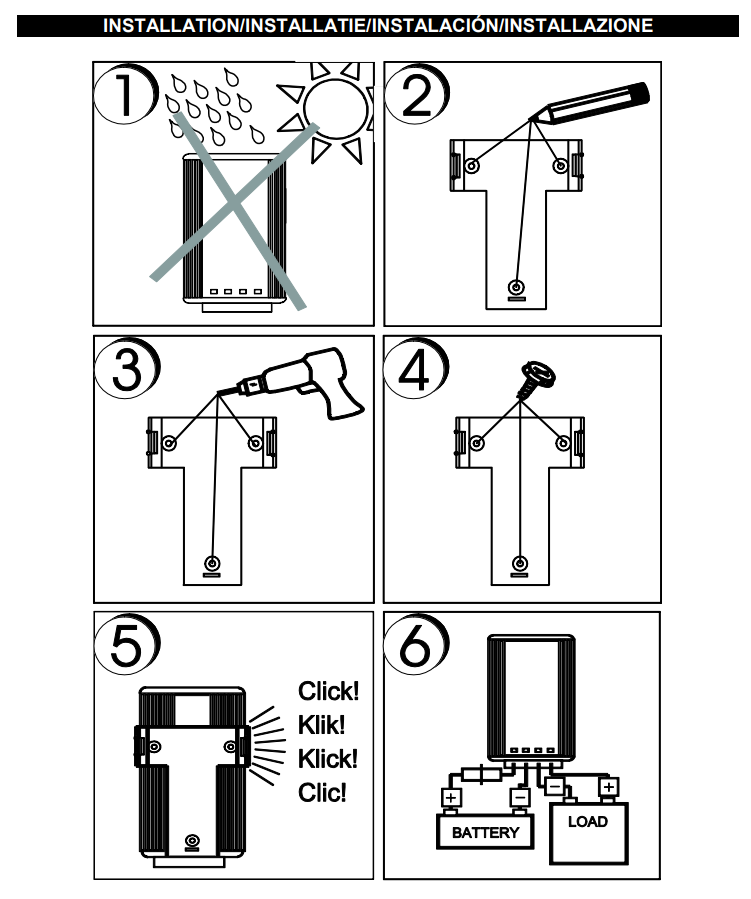
- Easy Installation: Compact, lightweight, and ships with all necessary installation components.
Important Note:
This converter is not compatible with AGM/MLI/Lead-acid batteries or smart multi-step charging systems. For battery charging, use the MAC Plus equivalent to avoid damage or thermal runaway.
Specifications
Specifications
Nominal Input Voltage: 24V
Input Range for Full output: 20-32V
Input range for no defects: 0-35V
Nominal output voltage: 13.6V
Max Output Power: 245 W
Nom. output power: 164W
Galvanic Isolation: No
Full output operating temperature: 0 to 30 °C
thereafter linear derating till 80 °C
Storage temperature : -25 °C to 85 °C
Maximum Current for 2min: 18A
Continuous Current rating: 12A
Consumption @24V input: <15mA
No load consumption @ 24V input: <10mA
Compliance: CE and E-mark; e11 020894, e13 023114
Ingress protection: IP53
Installation Details
Installation Details
Recommended to install in a dry, cool place.
Mounting Screws(included): 3x 5mm
Comes with everything you need
Pelagic Power Tip
Pelagic Power Tip
A galvanic connection is when a conductor is physically touching a conductor. Isolated converters use magnetic induction to create current, "galvanically isolating" the two sides of the converter. But don't worry, the DC Master isolating converters are shielded to prevent electromagnetic interference to nearby systems.
How do you know if your electronics should be powered by a galvanically isolated or non-isolated converter? Ask yourself these questions:
1) is your electronic sensitive to resistance, like a sensor, communication device, sender, audio equipment, or a network power?
If noise is not a problem, then continue to the next question.
If yes, then you should get an isolated converter to avoid affecting the resistance of the system by creating a grounding loop path through the converter, especially if the power source is a noisy power bus bar.
This creates what is called a "floating ground", an isolated system that prevents unintentional current flows, and voltage drops through long wire runs that alter the true ground of the system. If there is any conductor touching the hull of the boat for these floating ground systems, they would need be connected their own zincs.
2) Are you bonding two different underwater(or possibly electrically bonded) materials together through this converter that don't share ground?
If these materials don't share ground voltages, they can be electrically connected by seawater and a non-isolated converter, all the parts that cause galvanic corrosion. Isolating the two systems will prevent galvanic corrosion, saving your conductors and extending the life of your zincs.
3) Is there any medical equipment or dangerously high voltage equipment being connected?
If yes, then to avoid any chance of anyone being hurt, it would be wise to isolate medical equipment from a bigger electric system. If your converter was not isolated, and the person connected to the device touched any part of the grounding path, they would also become a path to ground (not fun). It is best to have an electrically and physically isolated floating ground to avoid this.
4)Does your electronic switch power, or require a separate floating ground?
If your device switches to AC power, you should have a separate ground in order to power going back up the converter, and also for more accurate AC waveforms with 0 bias voltage.
If your device is specified to need a floating ground, or to be electrically isolated from a converter, you should go ahead and do so.
Low stock: 2 left
Couldn't load pickup availability